1720 smart hard drive detects imminent failure что это
1720 SMART Hard Drive обнаруживает неизбежный сбой
Некоторые пользователи ПК сообщают, что при загрузке устройства с Windows 10 они получают сообщение об ошибке. Жесткий диск 1720 SMART обнаруживает неизбежный сбой на черном экране. В этом посте мы определим потенциальные причины, а также предложим наиболее подходящие решения, которые вы можете попробовать, чтобы быстро настроить и запустить свою систему.
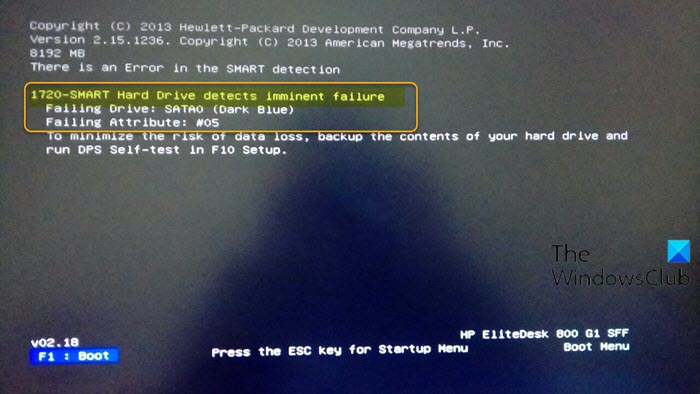
Значения для SATA может варьироваться от 0, 1, 2, 4 и т. д. Также значения для Атрибут может варьироваться от 05, 01, C8, 255, B8 и т. д.
Ниже перечислены потенциальные виновники этой ошибки:
1720 SMART Hard Drive обнаруживает неизбежный сбой
Если вы столкнулись с этой проблемой, вы можете попробовать наши рекомендуемые решения в указанном ниже порядке, чтобы решить эту проблему. Но прежде чем начать, по возможности, попробуйте сразу же сделать резервную копию данных на внешний жесткий диск.
Давайте посмотрим на описание процесса, связанного с каждым из перечисленных решений.
1]Очистите батарею CMOS
Система мониторинга SMART может фактически отображать ложное срабатывание из-за кэшированных данных, которые поддерживаются CMOS (Дополнительный металл-оксидный полупроводник) аккумулятор — это так, если вы уже переключили якобы неисправный диск и все равно получаете ту же ошибку. В этом случае вы можете очистить батарею CMOS и посмотреть, поможет ли это.
Вам могут потребоваться услуги специалиста по аппаратному обеспечению.
Если батарея находится в держателе, обратите внимание на ориентацию + и — на батарее. С помощью средней отвертки с плоским лезвием осторожно извлеките аккумулятор из разъема.
Если аккумулятор подключен к бортовой колодке с помощью провода, отсоедините провод от бортовой колодки.
Если загрузка не удалась из-за той же ошибки, попробуйте следующее решение.
2]Запустите CHKDSK
Если результат SMART является ложным срабатыванием, это может быть просто случай с поврежденными секторами на вашем диске, из которых CHKDSK является одним из жизнеспособных решений, которое может быть эффективным для устранения этой проблемы. Итак, если каким-то образом вашему компьютеру с Windows 10 удается загрузиться на рабочий стол, вы можете запустить встроенный инструмент CHKDSK или попробовать стороннее программное обеспечение для проверки ошибок диска, но если вы не можете загрузиться на рабочий стол, и у вас есть Запасной ПК, вы можете подключить неисправный диск через USB в качестве внешнего диска и запустить CHKDSK.
Если проблема не устранена после выполнения операции CHKDSK, попробуйте следующее решение.
3]Проверьте состояние диска
На этом этапе можно с уверенностью предположить, что вы имеете дело с неисправным диском, который вот-вот выйдет из строя. Однако, как уже отмечалось, известно, что мониторинг SMART вызывает некоторые ложные срабатывания, поэтому мы рекомендуем вам проверять состояние диска с помощью стороннего инструмента, такого как Speccy.
После того, как вы скачали и установили Speccy, сделайте следующее:
Утилита предоставит вам обзор около 30+ точек SMART, на которые вам нужно обратить внимание. Если измерения выходят за пределы нормального диапазона, можно с уверенностью заключить, что дисковый накопитель неисправен. В этом случае вы можете перейти к следующему и последнему решению.
4]Заменить диск
На этом этапе, после ваших тестов и исследований, вы пришли к выводу, что рассматриваемый диск неисправен — единственный вариант прямо сейчас — заменить неисправный диск и попытаться восстановить как можно больше файлов.
Итак, если вы можете загрузиться на рабочий стол, вы можете использовать внешний диск или любую доступную облачную службу хранения для резервного копирования всех ваших важных файлов. Однако, если ваш диск частично поврежден и вы не можете загрузиться на рабочий стол, вы можете либо сохранить свои данные / файлы с помощью программного обеспечения для создания образов дисков, либо использовать Linux Live USB для извлечения файлов, либо вы можете подключить неисправный диск через USB как внешний диск на другой компьютер и скопируйте нужные файлы.
После замены неисправного диска и чистой установки Windows 10 на новом исправном диске вы можете приступить к восстановлению клонированного образа или только файлов, восстановленных с помощью USB.
[Fix] Ошибка «Жесткий диск 1720-SMART обнаруживает неизбежный отказ»
Некоторые пользователи Windows сталкиваются с ошибкой 1720-SMART Hard Drive Detects Imminent Failure при каждой загрузке, из-за чего они не могут загружаться постоянно (или вообще в некоторых случаях). Подтверждено, что эта проблема возникает в Windows 7, Windows 8.1 и Windows 10.
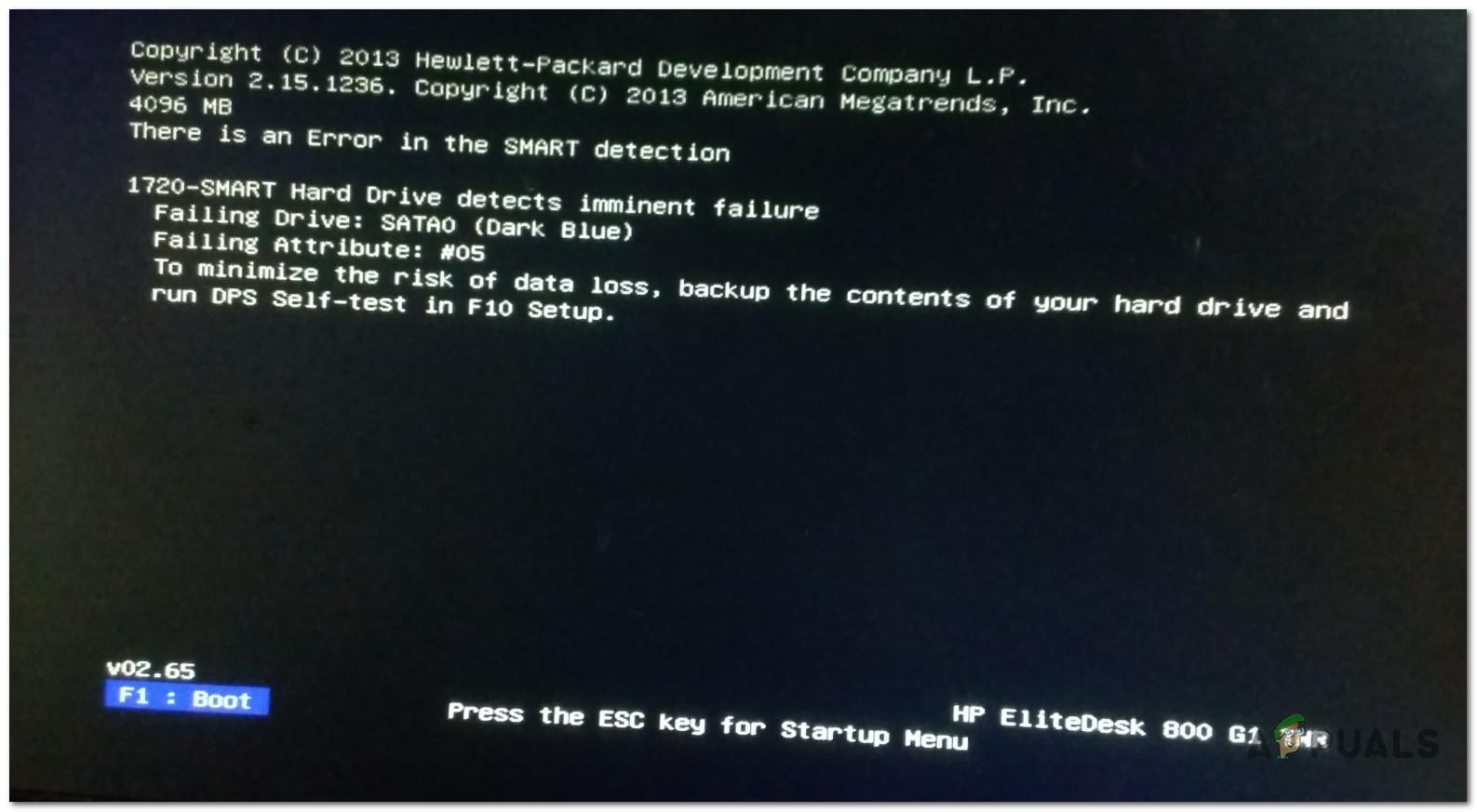
Как выясняется, существует несколько различных причин, вызывающих этот код ошибки. Изучив эту проблему, мы составили список потенциальных виновников, на которые вам следует внимательно изучить:
Теперь, когда вам известны все потенциальные виновники, которые могут быть ответственны за эту проблему, вот набор различных методов, которые пользователи, столкнувшиеся с одной и той же ошибкой 1720-SMART Hard Drive Detects Imminent Failure, успешно использовали для решения проблемы:
Метод 1. Очистка батареи / микросхемы памяти CMOS
Имейте в виду, что в некоторых случаях система мониторинга SMART может фактически отображать ложное срабатывание из-за кэшированных данных, которые поддерживаются батареей CMOS / микросхемой памяти. Это очень вероятно, если вы уже пытались заменить предположительно неисправный диск, но по-прежнему видите ту же ошибку 1720-SMART Hard Drive Detects Imminent Failure.
Если этот сценарий применим, первое, что вам следует сделать, это очистить батарею CMOS или микросхему памяти, в зависимости от того, какой тип технологии кэширования использует ваш компьютер. На настольных компьютерах эту задачу, вероятно, выполняет батарея CMOS (Complementary Metal-Oxide Semiconductor). В более новых моделях и, в частности, ноутбуках / ультрабуках он заменяется микросхемой памяти.
Нескольким затронутым пользователям, столкнувшимся с той же проблемой, удалось решить проблему, очистив батарею CMOS или микросхему памяти, тем самым очистив временные данные, вызывающие ложное срабатывание.
Чтобы упростить вам задачу, мы составили пошаговое руководство, которое покажет вам этот процесс:
Если вы по-прежнему видите ошибку «Жесткий диск 1720-SMART обнаруживает неизбежный сбой» даже после очистки батареи CMOS или микросхемы памяти, перейдите к следующему способу ниже.
Метод 2: Использование SPECCY для определения неисправного диска (если применимо)
Если описанный выше метод не сработал для вас, вам следует подумать о том, что вы можете иметь дело с неисправным HDD или SSD, который вот-вот выйдет из строя. Однако известно, что мониторинг SMART вызывает некоторые ложные срабатывания, поэтому в идеале вы должны найти время, чтобы выяснить, действительно ли ваш диск выходит из строя, с помощью стороннего инструмента.
Если вы ищете инструмент, способный сделать это, мы рекомендуем Speccy — он бесплатный, простой в установке и даст вам обзор около 30+ пунктов SMART, о которых вам необходимо знать. Если измерения выходят за рамки нормального диапазона, можно с уверенностью заключить, что дисковый накопитель неисправен.
Примечание: имейте в виду, что вы можете использовать этот метод только до тех пор, пока ваш компьютер может загружаться или у вас есть запасной компьютер, который вы можете подключить к предположительно неисправному диску в качестве дополнительного раздела.
Если вы еще этого не сделали, следуйте приведенным ниже инструкциям, чтобы установить Speccy на рабочий ПК и использовать его, чтобы определить, имеете ли вы дело с неисправным диском:
Если расследование, которое вы только что провели, указывает на неисправный диск, перейдите к следующему методу ниже.
Метод 3: клонировать и заменять неисправный диск
Если ни одно из возможных исправлений, представленных выше, не сработало в вашем случае, и вы провели расследование, чтобы убедиться, что диск, о котором идет речь, выходит из строя, единственное, что вы можете сделать прямо сейчас, — это заменить неисправный диск и попытаться его восстановить. как можно больше файлов.
Если вы все еще можете загрузиться с диска (время от времени), попробуйте сделать это и используйте внешний жесткий диск или облачную службу для резервного копирования всех ваших важных файлов.
Однако, если ваш диск частично поврежден и больше не может загружаться, единственный способ сохранить большую часть ваших данных — это использовать какое-то программное обеспечение для клонирования дисков. Есть много различных инструментов, которые позволят вам сделать это, и для большинства из них бесплатных планов достаточно, чтобы помочь вам в этом. Если вы рассматриваете этот вариант, вот список с некоторыми жизнеспособными программами для клонирования дисков.
Примечание: имейте в виду, что даже если программа не сможет скопировать некоторые файлы, расположенные в поврежденных секторах, вы все равно сможете спасти большинство ваших файлов. Обычно, если вы имеете дело только с несколькими поврежденными секторами на неисправном диске, новый «целевой» диск, скорее всего, будет содержать более 99% исправных файлов, восстановленных с неисправного диска.
[Fix] Error ‘1720-SMART Hard Drive Detects Imminent Failure’
Several Windows users are encountering the 1720-SMART Hard Drive Detects Imminent Failure error at every boot up, leaving them unable to boot consistently (or at all, in some cases). This issue is confirmed to occur on Windows 7, Windows 8.1, and Windows 10.
1720 – Smart Hard Drive Detects Imminent Failure
As it turns out, there are several different underlying causes that will cause this error code. After investigating this issue, we’ve put together a list of potential culprits that you should carefully look at:
Now that you are aware of every potential culprit that might be responsible for this issue, here’s a collection of different methods that users encountering the same 1720-SMART Hard Drive Detects Imminent Failure error have successfully used to resolve the issue:
Method 1: Clearing the CMOS battery/memory Chip
Keep in mind that in some cases, the SMART monitoring system can actually display a false positive because of cached data that’s being maintained by the CMOS battery/memory chip. This is very likely if you have already tried to swap the supposedly failing drive and you’re still seeing the same 1720-SMART Hard Drive Detects Imminent Failure error.
If this scenario is applicable, the first thing you should do is clear the CMOS battery or memory chip, depending on which type of cache technology your PC uses. On desktops, it’s likely that this task is accomplished by a CMOS (Complementary Metal-Oxide Semiconductor) battery. On newer models and laptops/ ultrabooks, in particular, this is replaced with a memory chip.
Several affected users dealing with the same issue have managed to fix the issue by clearing the CMOS battery or memory chip, thus clearing the temporary data that’s causing the false positive.
To make matters easier for you, we’ve put together a step-by-step guide that will show you through this process:
If you still end up seeing the 1720-SMART Hard Drive Detects Imminent Failure error even after clearing the CMOS battery or memory chip, move down to the next method below.
Method 2: Using SPECCY to pinpoint the Failing Drive (if applicable)
If the method above didn’t work for you, you should start considering the fact that you might be dealing with a failing HDD or SSD that is about to malfunction. However, SMART monitoring is known to trigger some false positives, so ideally, you should take the time to investigate whether your drive is indeed failing with a 3rd party tool.
In case you’re in the market for a tool capable of doing this, we recommend Speccy – It’s free, easy to install, and it will give you an overview of about 30+ SMART points that you need to be aware of. If the measurements are off the normal range, you can safely conclude that the disk-drive is failing.
Note: Keep in mind that you can only go for this method as long as your computer is able to boot up or you have a spare PC that you can connect to the supposedly failing drive as a secondary partition.
If you haven’t done this already, follow the instructions below to install Speccy on a working PC and using it to determine if you’re dealing with a failing drive:
If the investigation you’ve just performed points towards a failing drive, move down to the next method below.
Method 3: Clone & Replace Faulty Disk-Drive
If none of the potential fixes featured above have worked in your case and you did the investigations to ensure that the drive in question is failing, the only thing you can do right now is to get a replacement for your faulty disk drive and try to recover as many files as possible.
If you are still able to boot from the drive (from time to time), try to do it and use an external HDD or a cloud service to back-up all your important files.
However, if your disk is partially damaged and it can no longer boot, the only option to save the majority of your data is to use some kind of disk-cloning software. There’s a lot of different tools that will allow you to do this, and with the majority of them, the free plans are enough to help you do this. If you’re considering this option, here’s a list with some viable drive cloning software.
Note: Keep in mind that even if the software will be unable to copy some of the files located in bad sectors, you will still get to salvage the majority of your files. Typically, if you’re only dealing with a few bad sectors on your failing drive, the new ‘target’ disk-drive will likely contain over 99% of healthy files salvaged from the faulty drive.
1720 smart hard drive detects imminent failure
Received the following error: 1720 smart hard drive detects imminent failure. I replaced the hard drive with another new hard drive and still received the same error. I ran the diagnostic tests on the original hard drive with no detected problems. I remember at one time I had the same error coming up and HP had to replace a part on the motherboard. Am I having the same problem?
It is very unusual for a replacement disk-drive to cause the identical symptoms. Very unlucky!
What is the model-number?
Some HP computers have a small memory-chip in a socket on the motherboard, to be used as a «high-speed cache».
It is configured as a disk-drive.
So, if it «fails», you get your reported symptoms.
Power-off the computer.
Disconnect the AC power.
Remove the side-panel.
Find and remove that memory-chip from its socket.
Replace the side-panel.
Connect the AC power.
Start it up, and see if the symptoms still are present.
The HP Desktop Number is HP ENVY PHoeniz 810-145ae CTO. Where is this memory chip located?
is listed as having: 16 GB mSATA SSD Cache
It is this small chip, connected to a socket on the motherboard, that is the cause of your symptoms.
The fact that the replacement disk-drive did not «cure» the problem is an indication that the original disk-drive is OK.
has a picture of the motherboard.
In the picture, below the text: MS-7826 VER: 1.0
is a black-coloured socket (for PCI-E graphics adapter).
Below that is a white-coloured socket, for the mSATA chip.
Reboot, and the symptoms will not appear.
Welcome to this forum.
Please click the purple/white «Thumbs Up» icon for every response that is helpful.
Also, please click «Accept As Solution» for the best response.
Usually advise clients to run the sytem without the mSATA drive after it fails or move the operating system to a larger Solid State Drive.
If performance is not acceptable after removing the mSATA drive you can always copy the operating system to a new 500GB or 1TB SSD. You can keep the HDD as a bootable HP operating system backup or use the HDD as a data drive. HP Recovery media requires an equivalent sized or greater target disc when restoring the HP factory image.
So, this option may not work for you if you require the storage options HP offered at purchase (2TB or 3TB HDD’s) and you want to keep the bootable HP HDD operating system offline or more importantly because the HP recovery media may not work on smaller disk drives. Recovering the operating system to a smaller target SSD can be accomplished using other disk imaging software. There are workarounds to any problem. A suitable course of action depends on your specific circumstances. Buying a new SSD to replace the current HDD also costs money.
Giving you additional options for your consideration.
Larger SSD’s were very expensive when your PC was manufactured. MB manufacturer’s used this interface and small cache drive size to improve system responsiveness and keep costs under control.
SSD prices are very reasonable now.
Looking forward to hearing from mdklassen. Good working with you buddy! 
1720 smart hard drive detects imminent failure attribute
I keep getting this error message at boot up, have performed a back up and computer operating ok. do i need to replace hard drive. I have external hard drive I disconnected from the all in one due to another error message indicating windows detected hard disc problem WDC WD5000AAKX-6OU6AAO Volume:C:/D:/
Allow me to welcome you to the HP forums!
If your PC is running Windows 8 or newer, you should be able to follow these steps for testing the hard drive: Testing a Hard Disk from the BIOS | HP® Customer Support
If that shows the drive has failed, you would need to replace it.
***If my post helped, click the thumbs-up symbol to say thanks***
***Please mark Accept As Solution if my post solved your problem***
I am a volunteer and I do not work for, nor represent, HP
I have the same issue but the hard drive comes back good not failed. I also replaced the hard drive for testing purposes and I keep getting this error so i need to hit F1 on every startup to proceed to the operating system.
for an explanation of how your motherboard and your disk-drive continually monitor the «health» of the disk-drive.
> I also replaced the hard drive for testing purposes.
With a brand-new disk-drive, or with a «used» disk-drive?
If you have two disk-drives, connect them both, as «primary» and «secondary» drives.
Boot from one of the disk-drives.
Google-search for «download free SPECCY».
Download/install/run this software.
Expand the «Storage» section for one of the disk-drives.
Look at the details about the 30+ points that SMART is monitoring.
At least one of those measurements is «outside» of the normal range, indicating that the disk-drive is failing.
Expand the «Storage» section for the other disk-drive, and look again.
Tell us if one/both of the disk-drives are «failing».
Replace the disk-drive, ASAP.
Note that there does exist «disk-cloning» software, that also is «free», that can copy, byte-for-byte, from your current disk-drive to a brand-new disk-drive. This preserves your existing files & installed programs. Note that if the software is unable to copy a few sectors from the «source» disk-drive, then the «target» disk-drive will still have 99.999% of your files.